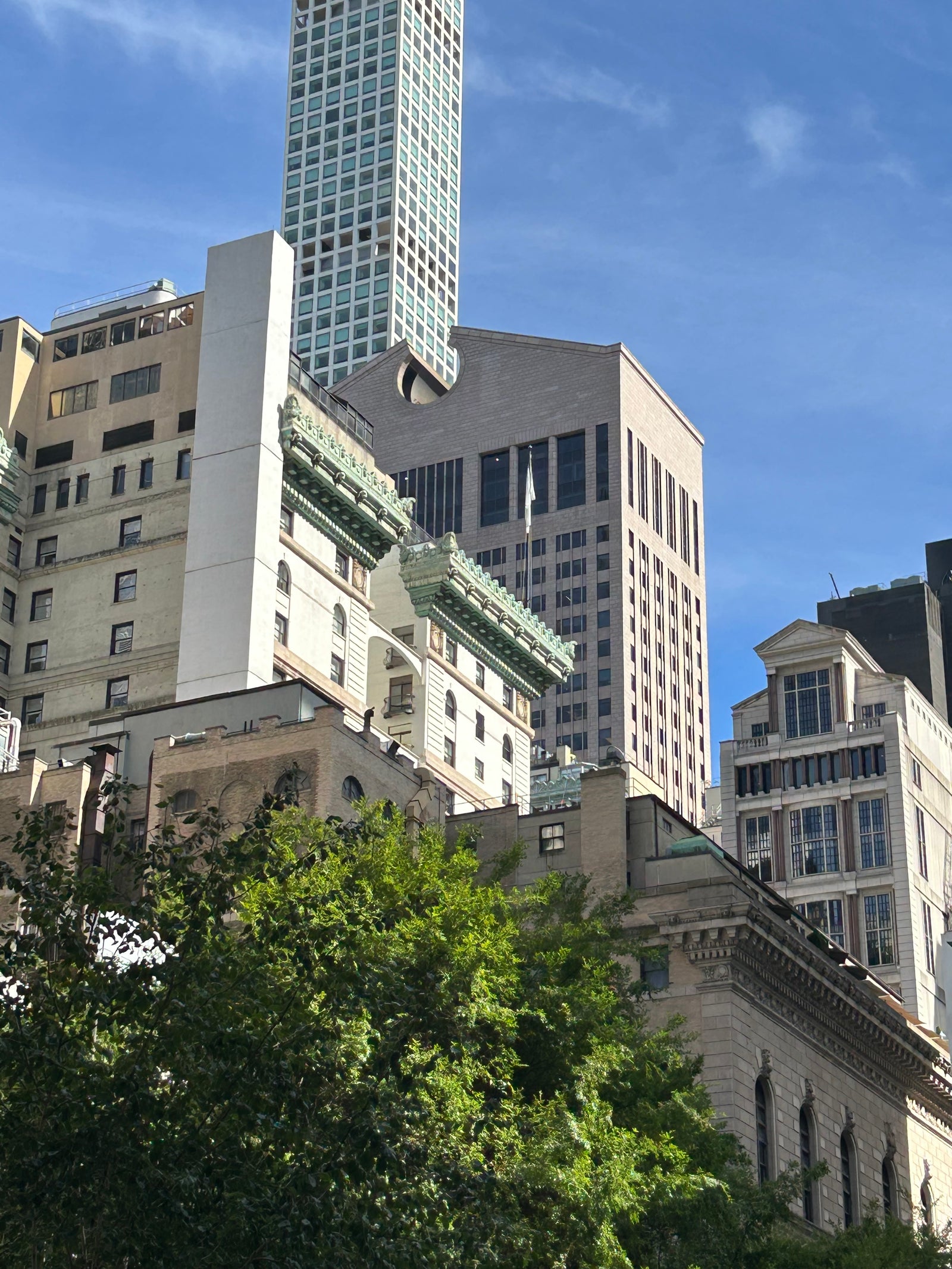
When you first glance at the photo, your eye is immediately drawn through distinct layers: the leafy tree canopy in the foreground, the richly detailed sandstone facades of mid-rise buildings behind it, and finally the tall, modern glass tower reaching skyward. These layers don’t just stack visually—they speak of time, material and scale interacting all at once.
The older façades convey texture and heritage: cornices, stonework, ornamentation hint at craftsmanship and decades of use. Behind them, the mid-rise structures form a transition in both height and style—bridging the scale between the street level greenery and the expansive modern tower rising beyond. Then the tower itself appears: sleek, grid-like, reflective, a marker of contemporary ambitions. Together, they form a visual dialogue of past and present.What makes this image compelling is how the tree canopy softens the harder edges, grounding the view in nature before you even reach the built environment. The height progression from trees to masonry to glass brings depth, literally and figuratively—you sense foreground, mid-ground, background, and feel the dimension of place. It’s not flat. It’s layered, textured, lived in.In architecture and place-making, this layering matters. When old and new buildings coexist visibly, they create context rather than isolation. They say: this place has history. It has evolution. In fact, design commentary highlights that blending old and new architectural elements—when done thoughtfully—gives buildings a “unique aesthetic” and meaning beyond mere style. The visual interplay of styles, heights and ages offers richness that a singular, uniform building rarely provides.For anyone depicting or interpreting property or neighbourhood narratives, pointing to this sort of layering invites the viewer into a richer story. Instead of simply presenting “a modern tower with city views,” you’re presenting “a layered skyline where heritage masonry meets contemporary glass, framed by mature trees.” That framing gives texture and identity. It communicates more than finishes—it communicates place.At the end of the day, architecture isn’t just about the new. It’s about its setting, its neighbours, its evolution. The building you see may be new, but when it sits beside older structures, beneath a leafy canopy, and in front of a skyline of varied height—the sum is greater than its parts. In this image, you’re seeing time, scale, design and nature aligned. And that’s a story worth telling.